My primary research interests lies at the intersection between optics and engineering. I like to use light to solve interesting problems! I also have research and engineering projects that support expanding curricular offerings in the department (e.g., labs and demonstrations). Last but not least, I am deeply passionate about making physics and optics accessible to individuals, particularly middle and high school students, who are might be intimidated or have no idea of how physics, light, and optics is cool and relevant to their lives.
Students interested in working on any of the projects listed below should email me at mbaylor at carleton dot edu. Prior coursework or research experience is NOT required, only an eagerness to learn and delve into hands-on (and occasionally theory/computational) work. Students can start working in my lab as early as their second term at Carleton.
Research Area 1: Particle Image Velocimetry
This project uses a spatial light modulator (SLM), a device that contains a grid of individually addressable liquid crystals that can change the phase of light, to produce computer controllable holograms. Though these holograms are not typically used to make pretty pictures, they are useful for encoding and recovering information impressed on a laser beam. This group is currently trying to use the SLM to measure fluid flows below a low-head dam, which often lead to drowning for those who happen to end up in such flows. The goal of this project is to visualize these flows and then explore interrupting the vector flow profile with the goals of saving the lives of individuals who fall into similar features in rivers.
Research Area 2: Integrated Optofluidic Devices
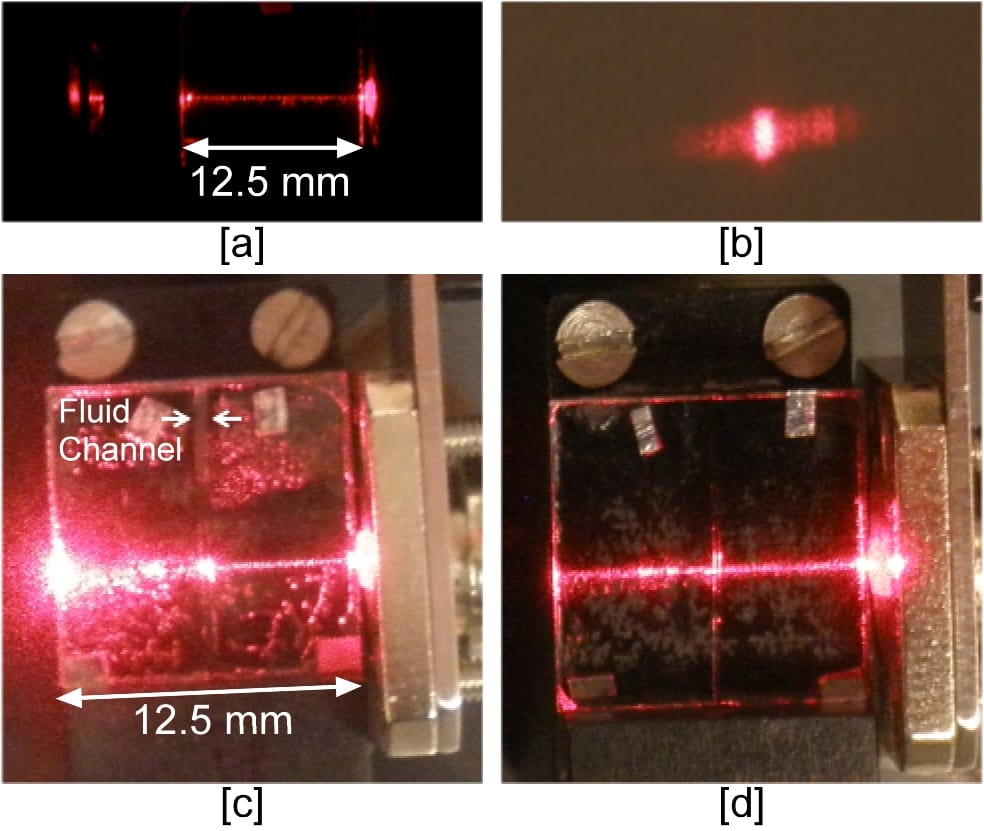
I’ve had fun combining my training in optical signal processing and electrical engineering and my interest in chemistry to move into the field of integrated optofluidic devices. I use light-sensitive plastics, called photopolymers, to simplify the fabrication of integrated optofluidic devices. Below is a device that I built. To read more about this device, read my article: Monolithic Integration of Optical Waveguide and Fluidic Channel Structures in a Thiol-ene/Methacrylate Photopolymer.
Current research students are building apparatus to measure various important characteristics of the photopolymers used for integrated optofluidic devices. These characteristics include: refractive index of the bulk resin, optical loss per unit length, maximum change in index of refraction, stiffness, etc. As we look at various resin formulations, we want to see how these properties change. Our goal is to provide a table of materials with properties for engineers so that they can choose the appropriate resin formulation for their application. For example, one application might require a rubbery material for wearable applications, while another might require a glassy material for working in harsh environments.
Research area 3: Fabrication of Macroscopic Polymer Lenses
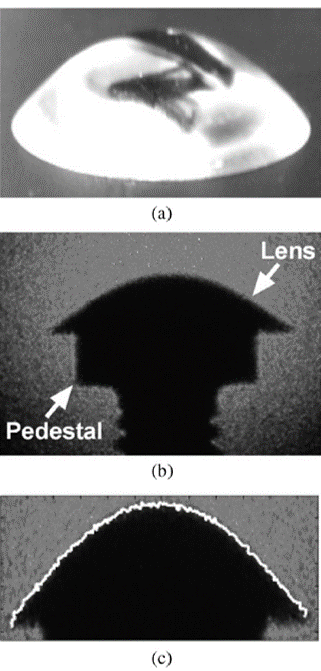
This research project was inspired by one of my research students, Charlotte Z. She was helping another student try to make a thin film with my polymer by suggesting that the student place a small amount of liquid resin on the surface of water. Hoping the drop of resin would spread uniformly over the surface of the water, they cured the resin with UV light. Instead, the resin formed a lens! The polymer formulation I use is hydrophobic. Due to the surface tension between the resin and water combined with the influence of gravity, the resin forms a curved surface that is hardened under UV-exposure. During her remaining three years at Carleton, Charlotte explored how different water-based substrates affect the shape of the lens. Her work, which she wrote up herself with supervision from me, is described in Effects of Varying Interfacial Surface Tension on Macroscopic Polymer Lenses.
An current extension of Charlotte’s initial work includes looking at how the hydrophobicity of the resin affects the shape of the lens. Partnering with Professor Rob Thompson in Carleton’s Math and Statistics Department, we are also trying to model the lenses using experimental parameters (e.g., relative surface tensions, resin volume, etc.). Dr. Thompson is involved in characterizing the optical performance of the lenses based on their shape. Our goal is to control the shape of the lens on demand for engineering applications. You can read about some of the work that Dr. Thompson and I have done with Carleton students in our paper Simulated Formation Of UV-cured Polymer Lenses On Aqueous Substrates.
Why is this work useful? Polymer lenses are cheaper to make than glass lenses. However there usefulness is limited in precision optical applications because polymer lenses cannot be polished. Thus their surface quality is not good enough for applications that require a very smooth surface to reduce scattering. The surface quality of polymer lenses is limited because they are typically made using molds – the lens can only be as smooth as the mold. By fabricating our polymer lenses on water or water-based substrates, our lenses are limited by the surface roughness of water. If we can control the shape of the lens, then polymer could be a viable option for precision optical applications, reducing their cost and increasing the usability.
Research Area 4: Curricular Lab Development/Research
Sometimes after completing a curricular lab, there are continuing questions that could lead to actual research questions but these questions can’t be explored during the lab time. Also, sometimes there is a lab that needs to be built and tested before it is used in the curriculum. Both types of projects lend themselves to students who want a hands-on project that has research and/or design components, but want a shorter time commitment (e.g., 1-3 terms, but maybe not multiple years). Occasionally these projects can lead to a summer research opportunity.
Research Area 5: Physics/Optics Education Outreach and/or Research
I am interested in opportunities to demonstrate optics and optical phenomena to K-12 students (mostly middle and high school students). Past projects include building a portable interferometer with complimentary LEGO exercises to teach precision measurement. Two new projects include building a laser maze and developing a hands-on electromagnetic waves course for students at a Guatemalan school. These projects would be of interest to students who are interested in hands-on activities, informal education, formal education, and/or physics education research. I am particularly interested in students who would like to combine their interests in physics, Spanish, and education/outreach.
(Inactive) Research Project: Measuring the Gel Point of Photopolymers Using NMR
This project is a collaboration between myself and Gretchen Hofmeister in Chemistry. In order to fabricate integrated optofluidic devices with my polymer, I need to know the optical exposure necessary to reach the gel point of the polymer. The gel point is defined as the point when a material has made the transition from being a solid to being a liquid. The common way of determining the gel point is using an rheometer. Although there is a rheometer at the University of Minnesota, it’s distance from Carleton and fee structure makes it challenging to use on a regular basis. Therefore we seek a technique to measure this crucial parameter locally at Carleton using our NMR instrument.
Selected Research Publications
* Indicates the name of a Carleton Student
- R. Thompson, S. Hempel-Costello*, Zack Johnson*, E.K. Schwartz*, S. Stevenson*, E. Weston*, M-E Baylor, “Simulated formation of UV-cured polymer lenses on aqueous substrates,” Optical Model and Performance Predictions, SPIE (2022). https://doi.org/10.1117/12.2639843
- C. Zimmerman*, M. White*, M-E. Baylor, “Effects of Varying Interfacial Surface Tension on Macroscopic Polymer Lenses,” Optical Engineering, 54 (9): 097108 (2015). https://doi.org/10.1117/1.OE.54.9.097108
- M. A. Tadayon, M-E. Baylor, S. Ashkenazi, “High quality factor polymeric Fabry-Perot resonators utilizing a polymer waveguide,” Optics Express, 22, 5904-5912 (2014). https://doi.org/10.1364/OE.22.005904
- M-E. Baylor, B. W. Cerjan*, C. R. Pfeifer*, R. W. Boyne+, C. L. Couch, N.B. Cramer, C. N. Bowman, R. R. McLeod, “Monolithic integration of optical waveguide and fluidic channel structures in a Thiol-ene/Methacrylate photopolymer,” Optical Materials Express 2, 1548-1555 (2012). https://doi.org/10.1364/OME.2.001548
